We have been using the Student Engagement Wheel from David Sladkey in The Professional Educator course to reflect on strategies, structures, resources to engage learners.
Each week students reflect on activities and tasks in a determined class period. Then they take on the role of the teacher and write a SMART goal for planning a more engaging class the following week. Listening to their ideas is super motivational for me. It makes me want to do better, too!
We received Kagan training before school started, so our department has challenged itself to implement and try new strategies then share at weekly PLCs.
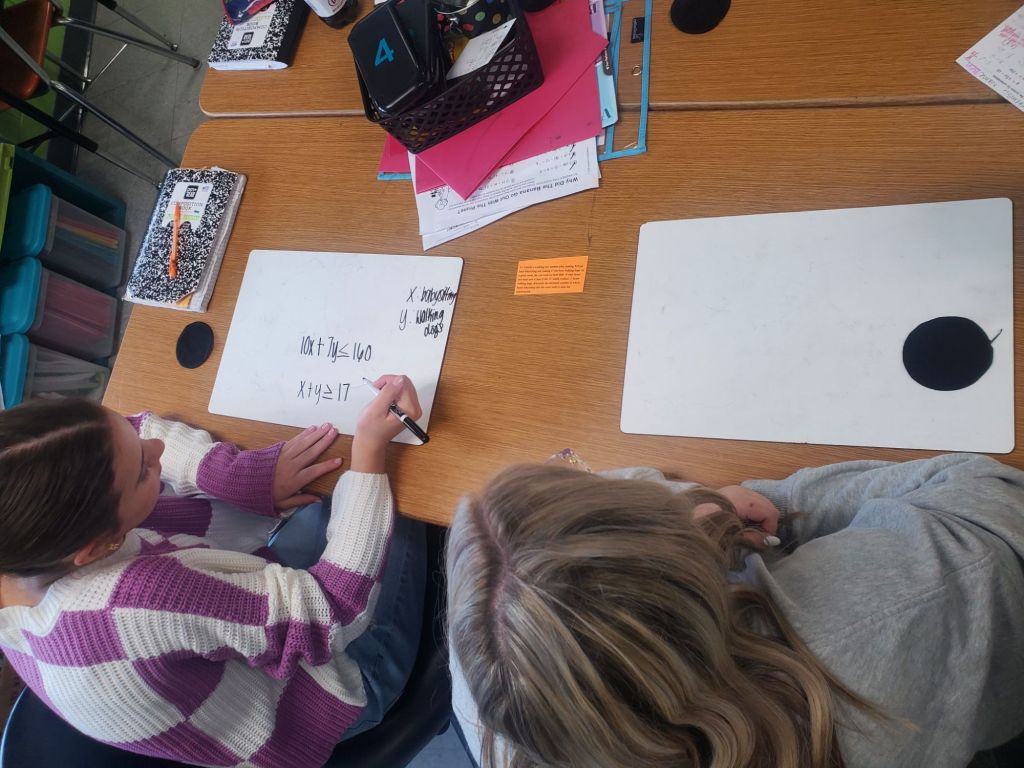
I chose Sage & Scribe these past 2 weeks. One marker per pair of students. One shares their thinking verbally and the other writes out the problem. They switch roles for each new problem.
Students said they liked the structure because it forced them to talk through their thinking process; it gave them someone immediate to help if they were stuck. It also allowed them to see/hear someone else’s thinking to build their own understanding and confidence.
One question, what do we do if we’re the scribe and they are telling us something we know is wrong? What do we do? Ideas? We can’t just tell them-because we see that as stealing their opportunity (my attempt to create a norm to coach- help, not tell) – so how might we ask a question, tell me why you chose to…, can we reread the problem for that part again?
Sage & Scribe
I created a set of 20 problems from Deltamath, printed and also the answer keys. I reduced the size of the answer key to 75%, used a gluestick to attach to back of question, then laminated.
Tables are set up with groups of 4, so each table got 2 cards. I quickly realized this was causing some groups to have to wait on others who took a little more time. So decided to put 3 or 4 cards at each table, so a pair who finished a little more quickly could continue and the other pair did not feel rushed.
Every 3-4 minutes, we passed each set of cards on to a new table, rotating the questions around the room.
I walked around and listened. This was great practice to solidify a skill students were not as confident in. The skill was to define variables and write inequalities system to model constraints.
I know now, since I have 8 tables, to create at least a 32 problem deck which allow enough for 4 problems per table. Also, I am attempting to create cards 2.5 x 4″ size so they will fit into plastic gum containers.
Use a plastic gum container to store.
What are some of your wins / opportunities to adjust using Sage & Scribe from Kagan?
Somewhere in Building Thinking Classrooms, was it consolidation? I read a snippet that when students are explaining their own group’s work, others were not engaged, listening.
The suggestion was to try to explain another group’s work. We tried that today. And what a great early task in the semester. We saw a need for labels, ways to follow their work, more accurate measurements when collecting data. After looking at other groups’ work, they wrote a reflection on ways they could have improved their own group’s work.
I believe this was eye opening for several. Looking at student work through a teacher’s eyes. Seeing other approaches. And having to explain someone else’s thinking was a different level for sure. They were given an opportunity to ask the group clarifying questions.
Several where did that come from? Why did you choose to do it that way? Even answers that were not even connected to the work…
It seems every time I blog in recent years, it follows a long space of silence.
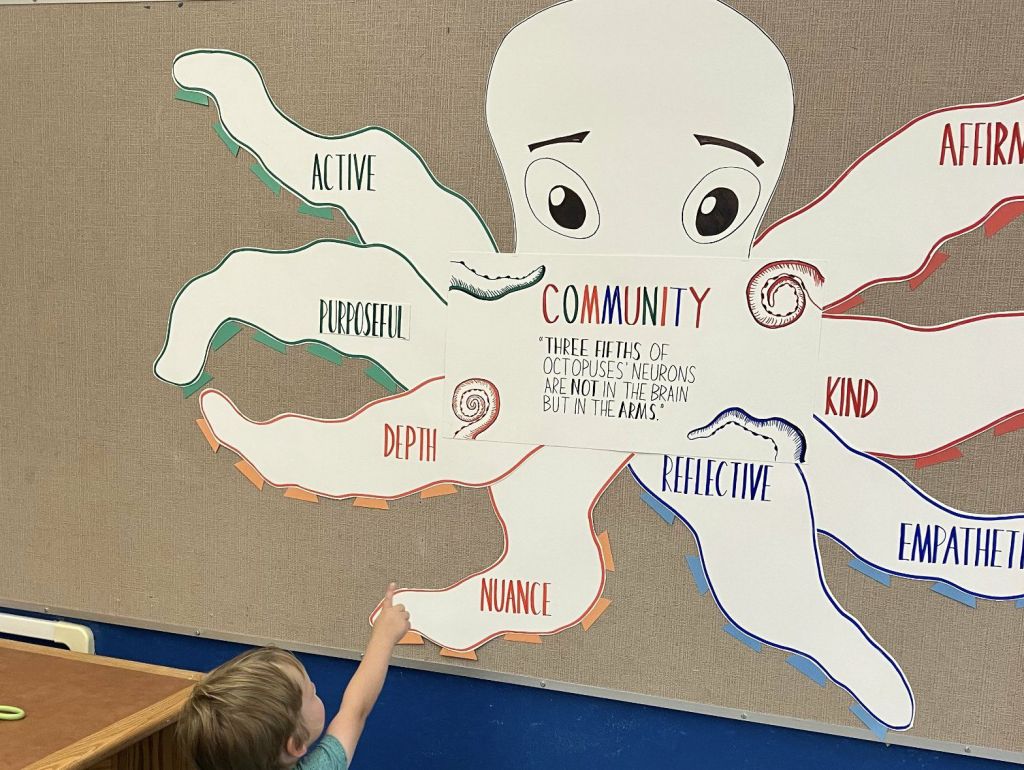
Did you know… 3/5 of octopus’ neurons are in their tentacles?
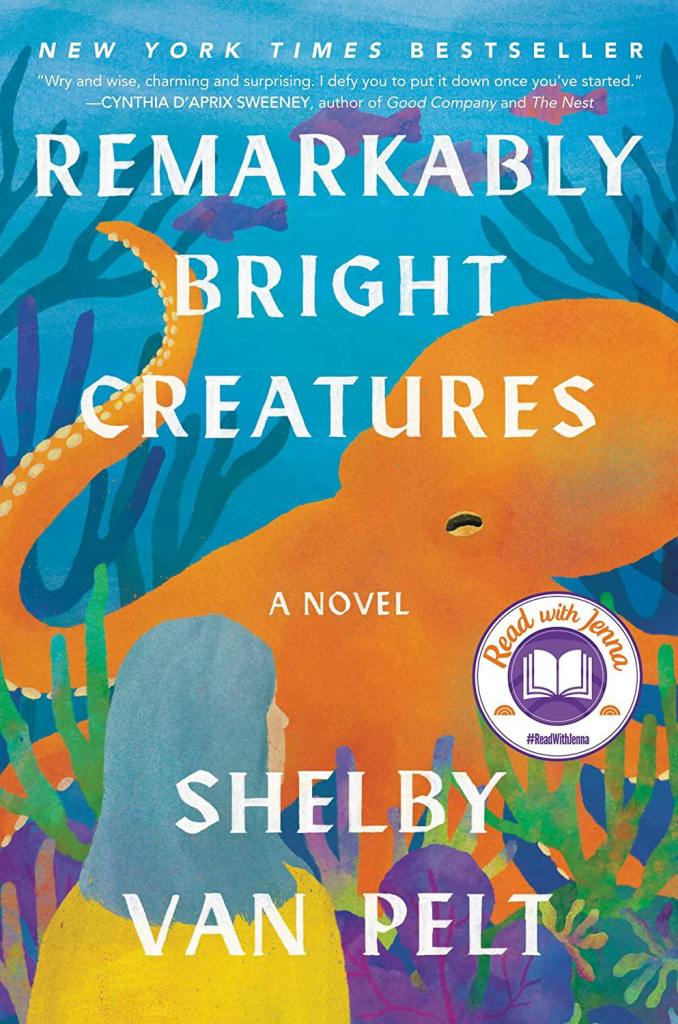
That bit of info grabbed my attention shortly after adoring Marcellus in Remarkably Bright Creatures. The cover and those colors are what drew me in to begin. I’m not quite sure what it was about the book, but it has stuck with me all summer.
Then that little factoid caught my attention and I wondered… could I somehow use it in my classroom this fall? To me it says, your smarts aren’t all about what’s in your head, but what work you’re willing to do as well.
I ran across this bulletin board and pondered since June how I might turn it in to an interactive bulletin board in Room 148.
Did you know…
Octopuses are smart? They can navigate mazes, solve problems, remember, predict, use tools and take apart just about anything from a crab to a lock? They have 3 hearts? They can camouflage to blend in? Have blue blood? And there are so many other cool facts about these creatures. SHEDD
So since teenagers are remarkable and bright creatures, how might I use the theme of octopus to encourage good habits and efforts, a sense of joy, a fun and safe environment?
My initial thought was to chooseb8 characteristics I’d like to celebrate in learners. Give them an opportunity to shout out to their peers when they notice them making good choices.
A friend suggested surveying them, then letting them vote for the top 8. What are 8 traits you think would be tops for the list?
Also find and read The Benefits of Being an Octopus, Ann Braden.
Thought I’d give this site a try. I feel like I’m finally starting to move out of the 3 year funk. And I want to be the reflective and effective teacher I was when I first started blogging.
Today was a day students were being called out to meet one on one with admin and counselors to build their schedules for next school year. So I knew they would be in and out of the classroom. I wanted something productive but also flexible for this reason.
Trying some lessons from Math Medic Algebra I, I ran across a review called Stinky Feet It reminded me of the old Ghosts the Graveyard. I basically cut up a worksheet, problems numbered, had an answer key ready to go and stickers!
Each table got a Stinky Sneaker. We used individual whiteboards for work. I had problems cut apart on a table and they’d grab one then exchange for a new one as needed.
Every person on the team had to write down the original problem and show the correct solution in standard form. If everyone was correct, they picked a sticker to decorate their Stinky Sneaker.
I set a timer to ensure we had enough time to tally points before leaving. Each color sticker was randomly assigned points at the end. Points were -5, 0, 5, 10, 20. And the team with most points claimed victory.
Yes, I know some kids copied, but it was their teammates (not me!) pushing them to complete it so the team could get their sticker. And what do you know, but a few of them picked up some skill and understanding along the way.
Yes, some groups worked faster than others. But there was discussion and debate all around. It was a fun way to get some needed practice. They enjoyed it. Good energy during those classes.
What’s a cost efficient and creative structure you use to get needed practice or review that your students enjoy?
This summer I have spent a lot of time reviewing old ideas, blog posts, books. I want to be that reflective teacher again, now that I don’t feel the need of survival from the past two years. Last year was my first “semi” full implementation of Building Thinking Classrooms. One of my challenges was creating/finding what I felt were good quality tasks. Though I love the idea of non-curricular, at the end of the day, I have to be intentional with content – it is Algebra I.
I’m not sure when I read this book. But have used excerpts through the years. In March 2018, our department used the Algebra section for discussion during an NTI Day. These were our prompts we used asynchronously in our PLC. After Reading – we were asked to reflect and complete the task #4 outlined below on another document, share link here OR email a picture of your hand written questions.
* Sentence/Phrase/Word – Share a quote (& page #) that is meaningful, engaging, or thought provoking to you from your reading.
Connect – How do these ideas connect to what you already know?
Extend – What new ideas extend or push your thinking in a new direction?
Challenge – How Might We Make Connections to Our Current Teaching Practices? What now is a challenge for you? What will you try? (you may wish to collaborate with like courses.
I used to think… Now I think…
I feel like our department needs to go back and review some of these old PLCs – there were some very thoughtful ideas shared.
What I like most about this book, it is split into different domains – algebra, geometry, number/operations, measurement, data analysis/probability. Within each, there are fantastic teacher tips as well as ideas and examples from 6-8 and 9-12 grade levels. My take away from this book – it is not about reinventing the wheel, but taking what you do, making small adjustments to create either Open Questions or Parallel Tasks. I agree this is more easily accomplished while bonncing ideas off with others. But it is a task that is doable and you end up with better questions in the end.
Which leads me to the file that made me ponder looking at this book again over the summer. I am not sure which TMC this was – but mornings with @marybourassa and @sheriwalker72 were fantastic! So many great conversations. It was one of my first true experiences of Building Thinking Classrooms from student perspective. Here is a copy of the shared document for Algebra and Function tasks.
When implementing the tasks – especially with BTC structure, you will find knowledge of Five-Practices for Orchestrating Productive Mathematical Discussions (Smith & Stein) VERY helpful. I’ll share about this awesome book in another #MTBoSBlaugust post!
Again – More Good Questions is so worth your time. Grab a couple of colleagues to go through it together. I am always up for another chat with it!
If you’ve used the ideas from Small and Lin’s book – please share, again we are our own best resources!
For some, summer break just began! For others, school starting is just around the corner. And a few have already started back. Whether you’re in a new role, new classroom or implementing some new strategies, reflect and share! We are our own best resources and we want to learn from you!
Possible Prompts:
How I teach / do ______ (INB, unit organizers/dividers, VNPS, VRG, BTC, topic of choice)
My Favorite “rich problem / task”
My favorite “rich problem /task” resource(s)…
Sharing an idea I learned at a PD event this past year
Something new I plan to try this year…
How I use ____(tech app of choice) in my classroom
Share a lesson that uses tech (Desmos AB, Geogebra, applets, etc)
Write a post related to pandemic teaching.
I want to grow as a #teacherleader this year by…
Share your #MTBoS Photo Challenge photos (#MathPhoto22)
Go on a “math walk” – take a photo to share with us… What do you notice? What do you wonder? How could you use this photo in your classroom
How do you handle homework / daily practice?
Self-Care… how to make it a priority?
Math Makeover – Take a traditional question/problem to solve and make it better.
My favorite go-to ____(Online resource, book, blog). Share an idea of how you have utilized this source.
Something I struggle with as a teacher/in the classroom.
How I used something unexpected in my classroom to…
#made4math – Create something you can use this semester, such as a tarsia puzzle, question stack, game, card sort, etc. (Or share one you have previously created)
#myoneword – What is one word that you can use to focus your energies this year?
What is your favorite quote? How can you share/use it in your classroom?
How do you handle Parent Communication? What has been successful for you?
Tell us about a favorite activity/lesson that makes you jump for joy when you get to use it.
Shoutouts! Give a shout-out to a former teacher, a colleague, or someone in your school or community who is a difference maker.
Time Capsule – revisit an old post and reflect. If you are new to blogging – find a post on this day from the past on someone else’s blog-read, share, reflect.
What’s a practice you keep doing year after year? Either something that works great or something that maybe needs examining. Why do you keep doing it?
What’s the one thing in your school year you’re most looking forward to? A lesson, a unit, a field trip, a school tradition
Fav [math][ed] book read and take aways for 2022-2023 (and beyond?)
Favorite non-ed book you’ve read so far this year!
What’s on your reading list?
How do you support struggling students? What intervention strategies have you used?
Observe yourself! Record your lesson using your phone in your pocket and use it to reflect
A peek into my classroom – show us your classroom or describe a typical day / hour
A Day in the LIfe (#DITL)
Letter to my first-year teacher self…
Tell us about your first day plans!
How do you develop a positive classroom culture?
What would you like to Start doing this school year? What would you like to Stop doing? What would you like to Continue doing?
What are your best organizational tips?
My classroom “must-haves” are…
Be the Change… what will you do this year to impact the culture of your school and/or classroom?
What is your focus / theme / mantra for the year and why? (Quote / Saying / Song?)
What are your favorite formative assessment strategies?
What is your Professional Goal for the year? Your Personal Goal?
What are your biggest classroom pet-peeves and how do you do handle them?
#Read3 – Share 3 blogs (or blog posts or tweets) that impacted you
Tell us about you! (20 facts or ABCs?)
What are your New School Year Goals or Resolutions?
What’s your “One Good Thing” for today?
#MyFavFriday – Tell us about your favorite moments of the week!
What do you do on parent night / open house?
What’s the toughest challenge you face as a teacher today?
How do you support / encourage colleagues?
What makes you/your classroom unique?
What are you most proud of in your school community?
What makes your community so special?
Three things on your bucket list.
What’s something/someone you want to celebrate from last school year? Maybe it’s something “that kid” did or said…
What is your school mascot? Describe a fun event / tradition in your school.
#teach180 – Share a photo from your classroom and tell us about it
What I did this summer….
Use these prompts or create your own! Blog daily, weekly, whatever works for you!
Oh yeah! Shared by @cogdog and @burnsidemath
#MTBoSBlaugust so we can all search and enjoy your posts!
Three weeks in to Summer Break and I know a few people are still in session. Wow. This summer is one of transition for our family, our daughter will be heading off to college this fall, there are a few weeks this summer she is out of town for work. There are days I wonder what my new identity will include in this transition.
I have been teaching summer school these past three weeks and its filled part of the void. It has also made me consider how to reach kids who may otherwise fall through the cracks during the school year. I have wondered how often I’ve missed identifying a student who needed screening for services. I have realized I am not trained for certain learning challenges some students face and that is when I need to ask for support myself of those in special education field – for suggestions, strategies I have not tried. There is nothing more frustrating than to see a student giving their best effort and still unable to grasp/hold on to certain concepts. I see it as an opportunity to dig in a little deeper and find other ways.
The remainder of my summer will be filled with reorganizing some spaces at home, visits with friends and family, morning coffee, afternoon reading in the sun and most importantly valuable family time. But it will also include a time of reflection, digging deeper from evaluations of this past year, searching and planning for ways to grow, improve. I hold close the idea shared by Steve Leinwand, the 10% rule. “Whether its 6 minutes of a class period, 18 days in the school year, an entire unit of study or one lesson within a unit…” focusing on improving 10% is very reasonable. One year, my goal was class closure. I began setting silent alarms on my FitBit 6 minutes prior to end of class and planned reflections for students to wrap up their thinking. It was easy, cost efficient, but took intentional action – now this is a consistent thing for me.
Someone asked me once why I choose to read so much during Summer Break. Well, once the school year starts, my feet hit the ground, I really don’t have the time to then. I ponder responses from students on my evaluations, reflect on my previous year’s PGP and choose some areas I would like to focus. My room is filled with somebody’s kids and I want to be the best for them as I’d want for my own child.
My Summer Goals…
With a spring semester of lasts with my senior, I let my health slip to the side. I want to make it a priority once again. Small steps each week to work my way back to a consistent and better routine.
#2022myreads goal has been to go through the alphabet by authors’ last names. I have a J book on hold in Libby app; I have checked out books for Z and X. I just need some suggestions for a book by an author whose last name begins with Y! So far, I have completed 40 books this year and with any luck and your suggestions, I’ll have completed my Authors’ Alphabet by summer’s end!
Summer professional reads and revisits from oldies, but goodies.
Things with good feedback from students that I want to continue: VNPS, VRG and Spiral Reviews. Improvements I would like to make are to build sets for VNPS using ideas from variation theory / thin slicing and suggestions from Mr. Barton’s book, Reflect, Expect, Check, Explain.
My biggest focus this school year with Building Thinking Classrooms will be the notes and consolidation. I’ve pondered the idea of leveling to the bottom this past year and feel that I have a good grasp of what it might look like now. A recent chat in #eduread of Michael Pershan’s Teaching Math with Examples has helped me sort through some of this.
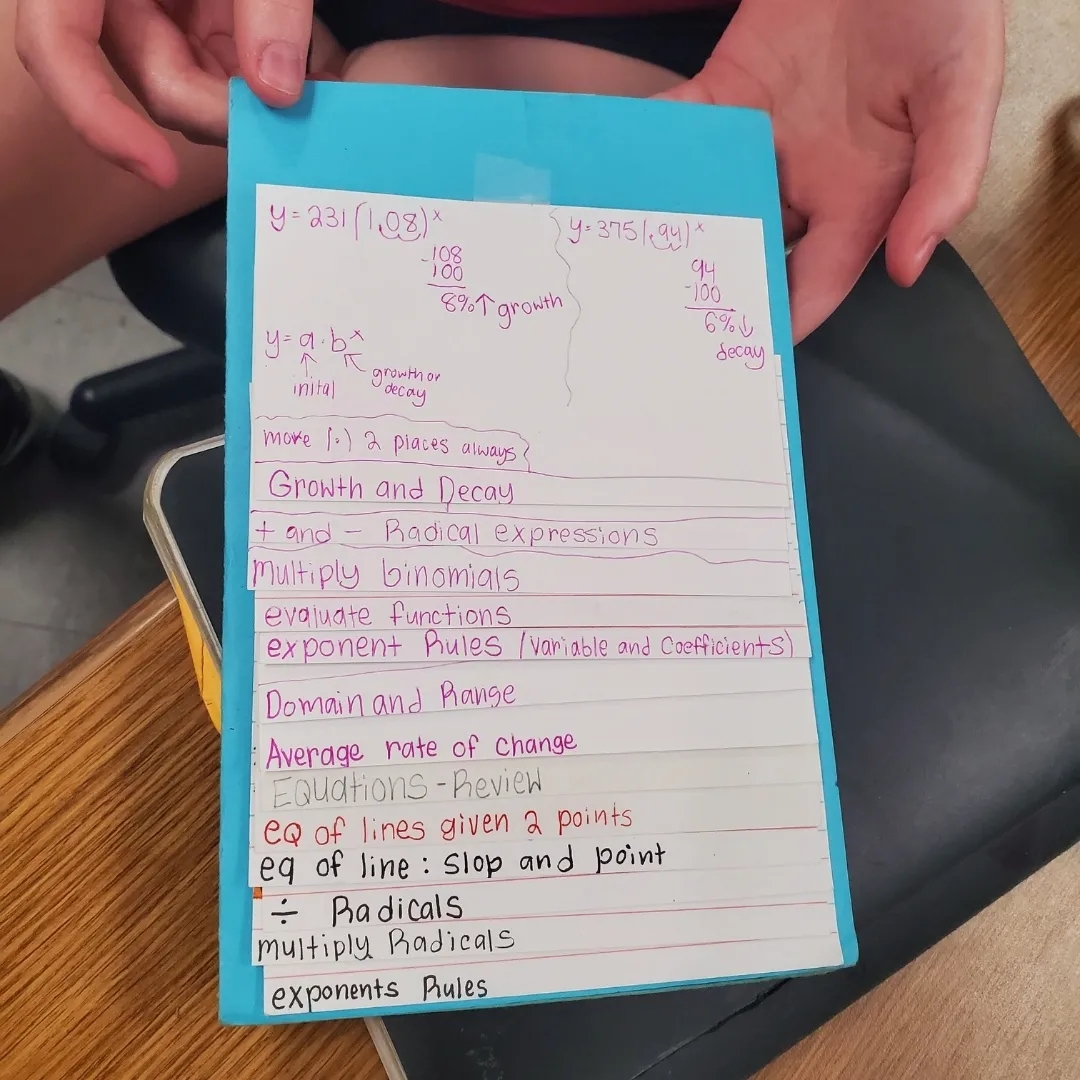
I want to realign my plans for Spiral Reviews to include BIG ideas from 8th grade curriculum for the first quarter, but then utilize Spiral Reviews to build upon the ideas of retrieval practice, interleaving and spacing as discussed from Powerful Teaching, Agarwal and Bain from a few summers ago. And many students loved our use of “flip chart cards” which included examples, notes, vocabulary highlighted in spiral reviews – they could quickly review and reference. I would like to find a way to improve and implement this tool as a means of international and regular review and reflection that would truly impact student learning. Memory is the residue of thinking. (Willingham?)
Cardstock folded in half. Index cards – title at the bottom, taped at the top so they can easily flip up and retrieve info on the back.
I am over the top excited as a colleague and I get to begin courses for our school’s Teaching and Learning Pathway. Essentially we will offer two courses, The Learning Community and The Learner Centered Classroom – which will introduce students interested in education to many facets of the pathway, visit different grade levels and learn about some of the behind the scenes work educators do. Their third course, The Teaching Profession will give them an opportunity to earn dual-credit as an intro to education class with a nearby college. As a possible fourth course, students will be assigned a placement to observe, collaborate and work within a classroom setting in our district. This is such a great opportunity for them to dip their toes in the water and see if education is truly a pathway they might like to pursue! Obviously there will be many hours invested in this new journey!
Books and resources for some of our T and L Pathway coursework.
As our district is in its 3rd year with Bounce Coalition and learning more about ACES – Adverse Childhood Effects – I want to explore an idea shared in a session, the blue dot. Whether I do this on my own or with my grade level team, we would look at our rosters, a blue dot is assigned to names of students involved in sports, clubs, extracurriculars, community groups, has a connection with an adult within our building, etc. The way I interpreted this idea – students who are without blue dots become a focus. Can we make a connection with them? Help them find an avenue of interest to become involved in the school opportunities or within the community. This idea has stuck with me ever since I heard about it.
Technology – I keep saying I’m going to learn a little Python; I’m interested in gathering information on becoming either a Google Certified Trainer or Innovator; But my biggest tech goal is to learn more about Computation Layer so I can build better Desmos AB tasks for my students and their learning. I’ve said it for years, but this is the summer I will do more with CL.
Some of these are goals I’d like to reach by end of summer. However, I am a realist and know many will continue throughout next school year. I look forward to next summer’s reflection to see how far I have come. What are some of your goals this summer?
June is half gone… the summer quickly passes by. So many times I feel inspired to blog and then something comes up and it gets pushed aside. We started an impromptu book chat last night – mostly because we had the book, it is somewhat a quick read and we felt we could get through a chat quickly enough to move on to other planned projects later this summer. Michael Pershan’s Teaching Math With Examples.
Take-a-ways for me from Chapter 1 and our chat= “Learning can only happen when careful thinking occurs.”
Self-explanation seems to be key (Rittle & Johnson) – Students read / access information superficially; they listen but don’t think in lecture heavy classrooms. The solution? Prompt students to explain.
Educational techniques are not magic. If they don’t provoke thinking, they don’t work.
Willingham: “Memory is the residue of thought.”
Students do not learn from a worked example – student learn when they think actively about a worked example.
This reading and the chat reminds me of a session I attended at KCM in March 2020 on Worked Examples with Mark Helton. I have my notes at school, but was able to locate these 3 snapshots of his handout. Will share more when I run across that folder.
KCM 2020, Mark Helton
Correct & Incorrect
In the book and mentioned in the chat was a resource shared by @jrykse I had on my to do list in 2020, but then online and virtual classrooms overtook my life. I will be checking this out before summer’s end. Algebra by Example from SERP Institute
Searching my old posts, looking for these handouts, I ran across this Post from a book study on Support for Struggling Learners and listed as one of the interventions was concrete examples. Again, revisiting this book as well as I prepare for next school year.
I have utilized Mathshell’s Formative Assessment Lessons for many years. The Concept Development Lessons give students an opportunity to do a task, allow you to give feedback. Then they actually analyze work from 4 student samples for the given prompt. Students are asked to determine if it is complete, correct and then reflect on what they like or would improve for each student sample. I cannot remember if it was Wilham’s work or someone else that suggested the benefits of using sample work to learn from / see exemplars / ways to improve.
However, it was some experiences this week in Summer School that have led me to see there is value here. A student was struggling to the point of tears, them and me both. I was frustrated because I whole heartedly believed one-on-one was all that was needed to help this learner start moving forward. No. Nothing I said, drew or demonstrated worked.
So I went in this morning a bit early, pulled up what I thought the student would be working on today and began creating worked examples along with a couple of you-try problems each. Of the 4 skills/topics we worked on, 3 were VERY successful. I started each with a warm up including vocabulary – word and illustrated; an example for them to tell me what you see / notice; then a moment with the worked example – focusing on how each line was alike/different, what action did they take from line to line. I stood by with the you try for support, then allowed them a chance on their own for feedback before jumping in the lesson. The day went so much more smoothly and the student accomplished much more as well. It felt good, no tears today.
The examples that they struggled on involved graphing lines. I wonder if I had a few problems with graphs so they could see differences between each if that would have been beneficial? I also found if they student wrote out the information on paper, sketched graphs on paper, they were more successful in completing the questions correctly. Just because a problems is on screen, does not mean you cannot paper-pencil it!!! For this student, writing the information helped them process the question, I believe.
I see the benefits. However I wonder if there are certain learners who benefit more from the structure of worked examples? I plan to utilize these with my collaborative section especially. I feel for ILP and ELL that having these concrete examples can provide a starting point in their work.
How do you implement worked examples in to your instructional practices? What successes / improvement have you seen and made a long the way?
I ran across this book after attending a virtual session at KCM last spring. I loved the thinking the routines shared by Mr. San Giovanni required of me and how open ended some tasks were.
The book has been on my shelf since last summer. I’ve flipped through it and scanned some of the tasks. Listening to Eric Milou & Steve Leinwand on a Making Math Moments Meaningful podcast, I was reminded of this book.
As I read through it this rainy afternoon, I feel its a quick implement to get kids engaged from the moment they enter class. 5 minutes is ideal: 1 to ponder, 2 to discussion in pairs/triads, 2 to share their reasoning.
It outlines the Five Practices for Orchestrating Productive Discussions from Smith & Stein as a structue in planning for a routine. For those not familar: anticipate, monitor, select, sequence and connect. I know this will often run over 5 minutes for me, but if students are engaged and sharing I feel it will bring value to our classroom.
The routines seem very flexible and you are encouraged to modify and create your own tasks. The tasks and examples shared in the book are great starting points.
I would love to have a colleague to share and reflect with. If you have used these routines, I would be grateful to hear your experiences, bounce some ideas on creating new tasks within each routine.
My intention is to utilize each routine 6-8 times over a 2 week period. This will allow students to become familiar with the structure. I intend to use content themat should not be new, but more review or remind from fall semester. There are 5 routines, so this will take us through spring break, I think.
Please feel free to share ideas or join in the fun!











 the radical rational...